Intro
Meet BugNexa: Continuous Black-Box Scanning for a Changing Attack Surface
7 min read
There are basically two kinds of security programs.
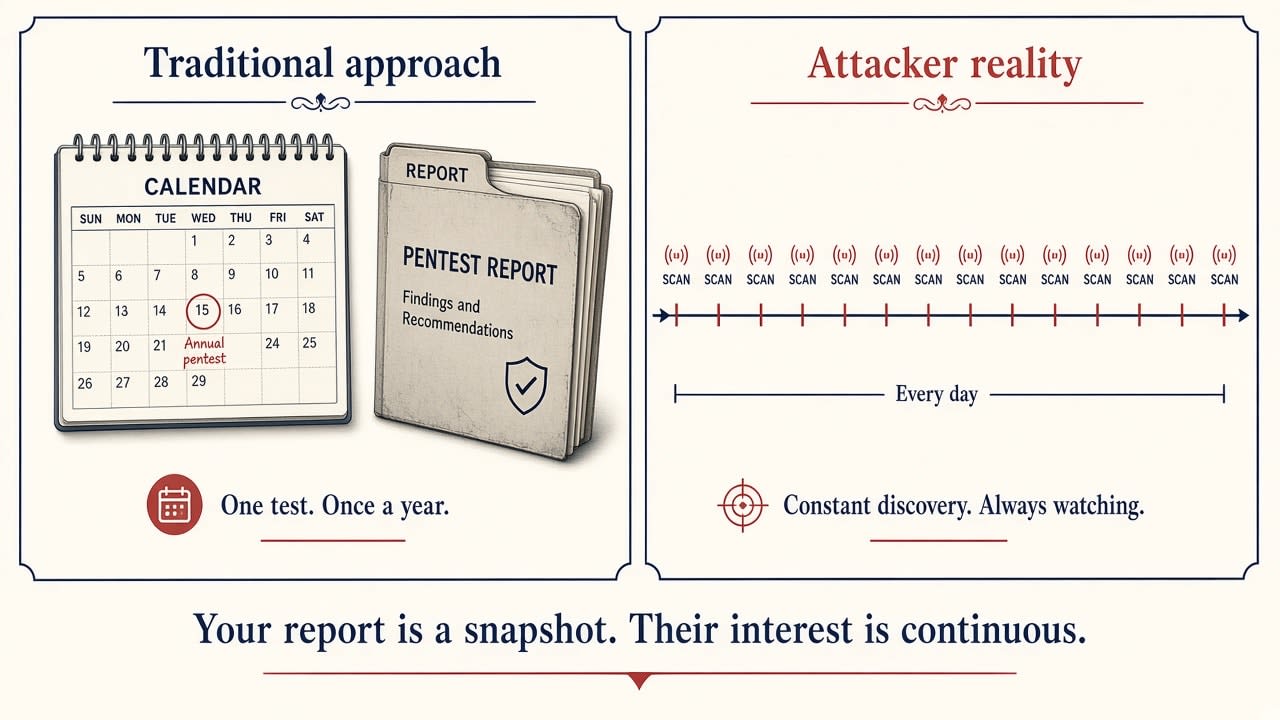
Those that assess their internet-facing attack surface once in a while — and those that recognize attackers are already scanning it all the time.
If you are responsible for keeping a product, network, or cloud perimeter secure, you have probably felt that gap. Attackers operate continuously. Many organizations still assess only occasionally. That gap is where risk quietly builds.
BugNexa exists for that gap.
What BugNexa Is
BugNexa is a continuous black-box security assessment platform. It helps authorized teams look at their external attack surface the way an outside attacker would — without waiting for the next expensive, slow, one-off security engagement.
In practical terms, BugNexa is:
A black-box vulnerability scanning and assessment platform
A central workspace for assets, scans, findings, and reports
A way to run on-demand assessments and scheduled continuous checks
A bridge between automated discovery and structured vulnerability management
BugNexa is operated with a clear product philosophy: authorized scope only, evidence-backed findings, and continuous follow-up — not a one-time PDF that ages the moment infrastructure changes.
What BugNexa Is Not
Clear expectations matter.
BugNexa is not:
A guarantee that every vulnerability will be found
A full replacement for every deep manual penetration test
A tool for unauthorized scanning or illegal activity
Like any serious security platform, BugNexa works best when used by teams that understand scope, risk, and responsible testing. Manual pentests remain valuable for high-assurance deep validation. BugNexa complements them by covering the long periods between those engagements.
Why the Attack Surface Won’t Sit Still
Traditional vulnerability management often looks like this: an organization commissions a manual assessment, receives a static report, remediates what it can, and waits months — sometimes a year — before doing it again.
That model made more sense when change was slower.
Today, teams ship features weekly. Infrastructure changes daily. New domains, APIs, cloud services, and vendor integrations appear faster than traditional review cycles can keep up. An annual or semi-annual pentest is still useful, but on its own it is only a snapshot.
In between snapshots, organizations can lose visibility into:
Newly exposed services and open ports
Misconfigurations introduced by change
Weak cryptography and certificate issues
Information disclosure and version leakage
Management interfaces that remain reachable
Issues that return because remediation was incomplete
BugNexa is built for that “in-between” period — when exposure can accumulate quietly while everyone assumes last quarter’s report still represents reality.
The Core Idea: Black-Box Assessment
“Black-box” means the assessment is performed from the outside, similar to how an external attacker approaches a target.
Instead of starting with privileged internal access, black-box testing focuses on what can actually be reached and observed from outside the perimeter.
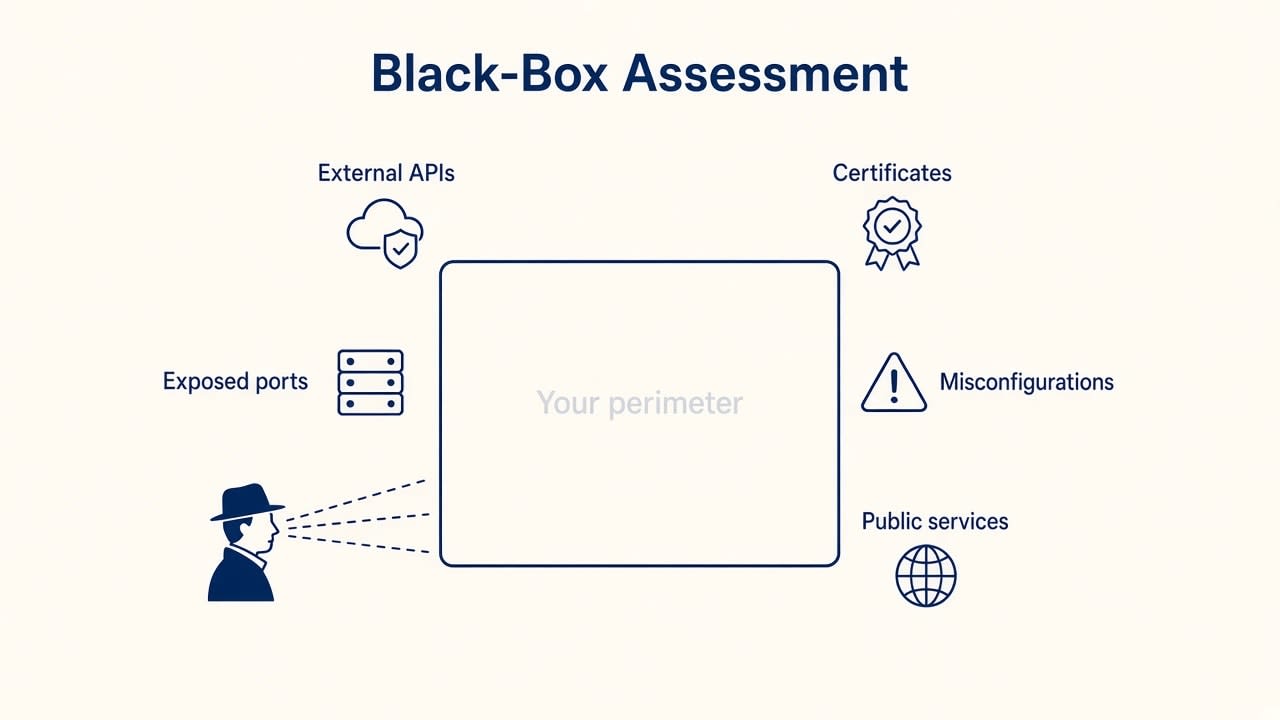
That includes:
Exposed services and open ports
Application and API behavior visible externally
Configuration weaknesses and protocol issues
Weak cryptography and certificate problems
Disclosure of software versions or sensitive details
Security weaknesses that can be evidenced through external interaction
This model answers a practical business question:
What could someone discover or exploit if they were outside our perimeter looking for weaknesses?
That is the question BugNexa is designed to help teams revisit continuously — not only once a year.
How BugNexa Fits Into Real Security Work
Here is how teams typically use the platform.
1. Manage your authorized attack surface
Everything starts with scope. BugNexa lets teams register and organize assets they are authorized to assess — such as domains, IP addresses, web applications, and related targets. This keeps testing inside approved boundaries, tracks what has been assessed, and makes it easier to compare exposure over time.
2. Run on-demand vulnerability scans
Sometimes you need answers immediately: before a major release, after infrastructure changes, during vendor onboarding, or ahead of a compliance window. BugNexa supports on-demand scanning so teams can start an assessment when the business needs it.
3. Schedule continuous scanning
One of BugNexa’s biggest strengths is continuity. Scheduled scans help organizations repeatedly check external exposure and see how risk changes over time — giving security teams earlier warnings instead of late surprises.
4. Collect and organize findings
A scan that produces a wall of unreadable output is not useful. BugNexa turns assessment activity into structured findings, with context about what was found, where it was found, why it matters, how severe it appears, and what evidence supports it.
5. Support evidence-driven analysis
Where enabled, BugNexa can support AI-assisted interpretation of evidence to help structure findings and reduce manual effort. The goal is not to invent issues — it is to help teams work faster with real, reviewable assessment results.
6. Generate reports teams can use
Security work loses value when findings stay trapped inside a tool. BugNexa supports report generation and export so results can move into remediation discussions, engineering backlogs, leadership updates, and compliance reviews.
7. Operate from a central dashboard
Through a central dashboard, teams can track scans, findings, assets, and activity in one place. BugNexa also includes organization and team controls, role-based permissions, credit-based usage tracking, and secure authentication options such as optional 2FA/OTP to help protect sensitive assessment data.
How BugNexa Works: A Simple Lifecycle
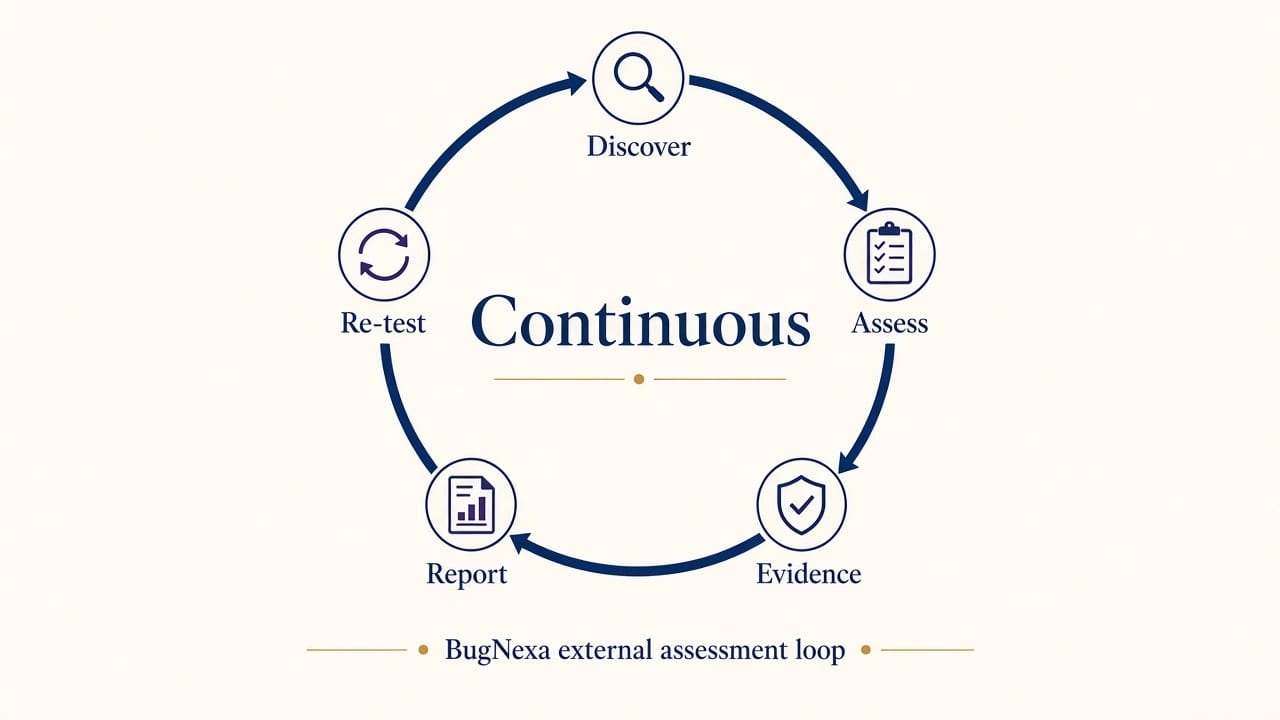
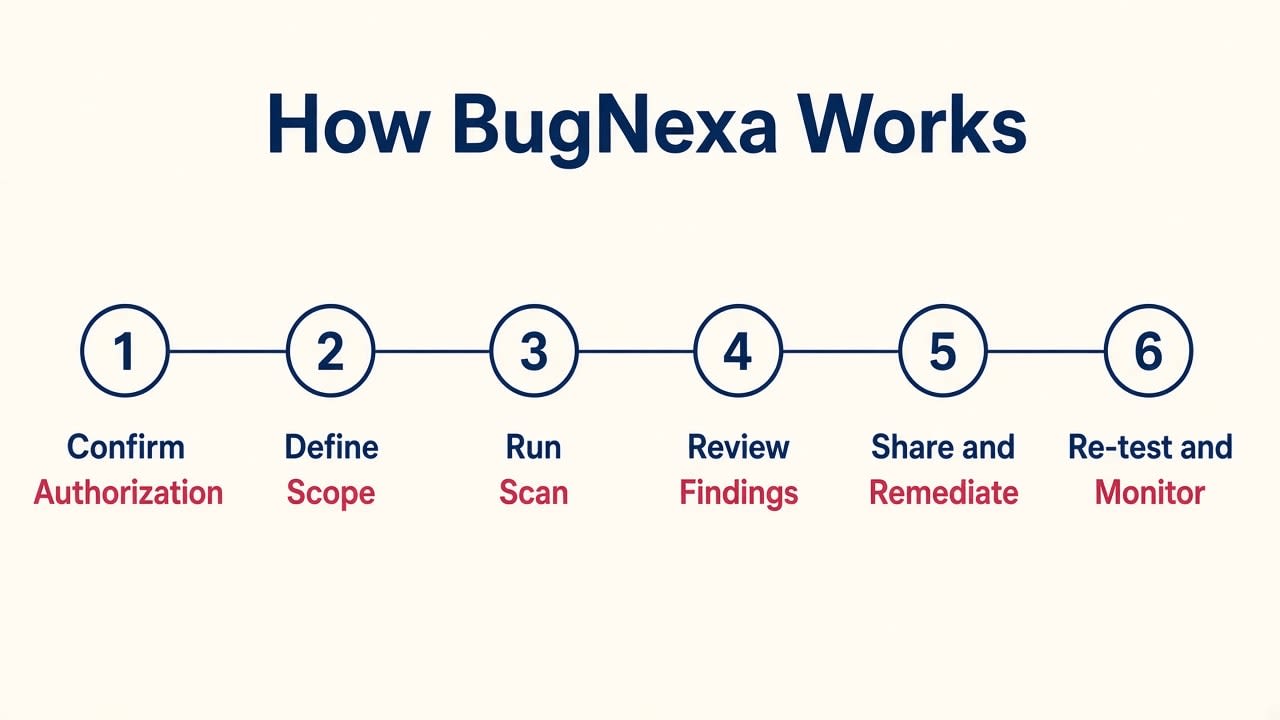
The workflow inside BugNexa follows a repeatable cycle:
Confirm authorization — Make sure you own the target assets or have explicit permission to test them.
Define scope — Register the domains, IPs, and applications you are authorized to assess.
Run the scan — Launch an on-demand assessment or set up a recurring schedule.
Review findings — Prioritize issues by severity, exposure, and business impact using available evidence.
Share and remediate — Export reports, assign fixes, and coordinate with engineering owners.
Re-test and monitor — Verify remediation and keep scanning as the environment continues to change.
That last step is essential. In a changing attack surface, “fixed once” is not the same as “still fixed.”
Who BugNexa Is For
BugNexa is designed for:
Security teams who need recurring visibility between formal pentests
Engineering and DevOps teams who want faster feedback when shipping changes that affect public exposure
MSPs and security vendors who manage multiple client environments and need structured delivery workflows
Founders and product companies who need to demonstrate basic security hygiene without building a full consulting function overnight
Compliance-minded organizations that need evidence of ongoing assessment activity
If your external surface changes faster than your assessment calendar, BugNexa is built for that reality.
BugNexa vs Traditional Penetration Testing
Feature | Traditional Penetration Testing | BugNexa Platform |
|---|---|---|
Methodology | Deep manual expertise | Continuous / on-demand black-box scanning |
Frequency | Point-in-time snapshot (often annual) | Recurring, continuous, or instant on demand |
Turnaround | Limited by schedule and consultant availability | Fast turnaround for ongoing checks |
Primary value | High-assurance deep validation | Continuous visibility, drift detection, and remediation follow-up |
The goal is not to replace manual pentests. The goal is to stop relying on pentests alone.
Use continuous black-box scanning for ongoing visibility. Use expert manual testing when deeper validation is needed. Together, they form a stronger program than either approach in isolation.
A Practical Example
Imagine a company with twenty public-facing IP addresses supporting production infrastructure.
An annual external assessment still has value — but a year is a long time in modern infrastructure. New services appear. Firewall rules change. Certificates expire. Temporary exceptions become permanent.
With BugNexa, the same team can run periodic authorized external checks, review structured findings with severity and evidence, generate reports for remediation planning, and re-assess after fixes. The result is earlier identification of external risk and more consistent security visibility — not only a once-a-year snapshot.
Responsible Use Is Non-Negotiable
BugNexa should only be used on systems, networks, applications, APIs, domains, or IP addresses that you own or for which you have explicit written permission to test.
Unauthorized testing can create legal, operational, and ethical consequences. Responsible security work starts with clear authorization. BugNexa’s product model assumes authorized scope — and that boundary should never be treated as optional.
Why “Continuous” Matters More Than Ever
Attack surfaces are not static documents. They are living systems.
Every deployment, every cloud change, every new subdomain, every vendor integration can alter what is visible from the outside. Continuous black-box scanning does not eliminate risk. It reduces the time between change and awareness.
That is the difference between discovering exposure in days versus discovering it in next year’s report - or worse, discovering it after someone else already has.
BugNexa is built to shorten that window.
Getting Started
If you want to see how BugNexa could fit into your attack-surface program, compliance goals, or continuous external scanning workflow:
Visit:
Create an account and explore the platform
Contact: support@bugnexa.com
Start with assets you are authorized to assess. Define scope carefully. Run your first scan. Review findings with evidence. Then schedule the next one — because your attack surface will not wait for the next annual engagement.